
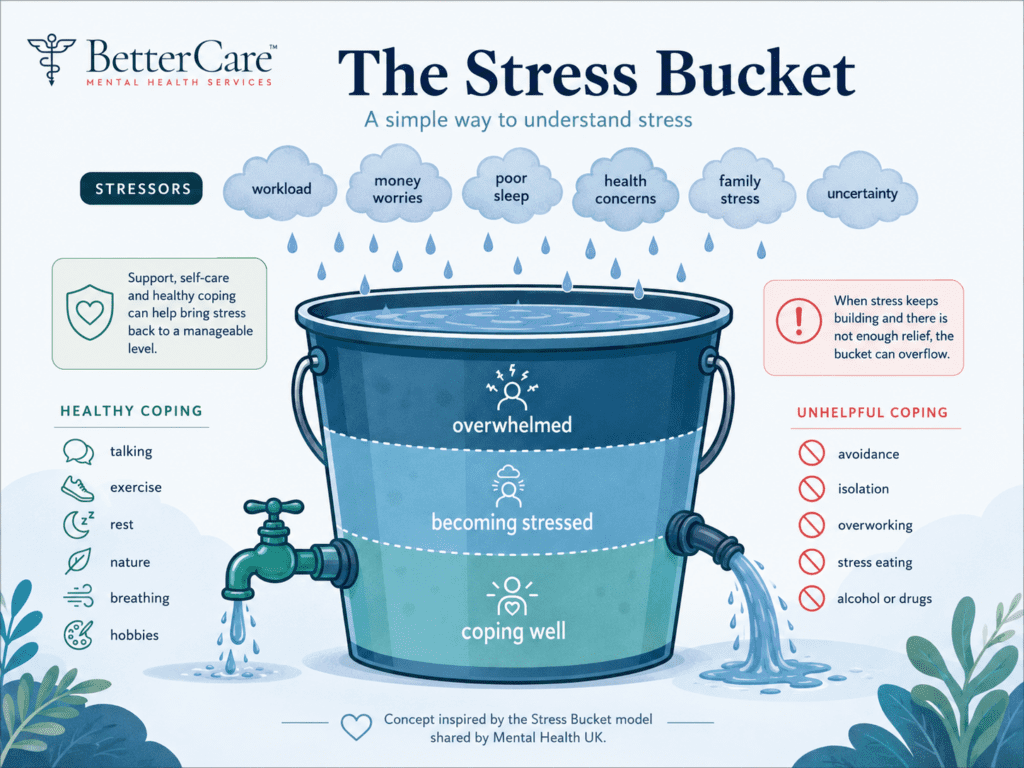
Concept credit: Inspired by the Stress Bucket model shared by Mental Health UK.
Everyone experiences stress. In small amounts, stress can help us focus, respond to challenges and get things done.
But when stress builds up over time, without enough recovery or support, it can start to affect our mental health, physical health, relationships, work and daily life.
One simple way to understand this is the Stress Bucket.
What is the Stress Bucket?
The Stress Bucket is a visual tool that helps explain how stress builds up and how coping strategies can help reduce it.
Imagine you have a bucket. This bucket represents your capacity to manage stress, pressure and challenges.
Above the bucket are rain clouds. These are the things adding stress to your life. Some may be expected, such as a busy period at work. Others may come suddenly, such as illness, bereavement, financial pressure or family conflict.
As these stressors continue, the bucket begins to fill. If too much goes in and not enough comes out, the bucket can overflow. This is when stress may begin to feel unmanageable.
What fills your stress bucket?
Stressors are different for everyone. What feels manageable for one person may feel overwhelming for another, depending on their circumstances, health, support system and current capacity.
Common stressors can include:
- work pressure or workload
- poor sleep
- money worries
- health concerns
- relationship difficulties
- family conflict
- caring responsibilities
- housing concerns
- exam pressure
- uncertainty about the future
- major life events, including loss or bereavement
Sometimes the problem is not one big thing. It is the steady build-up of many smaller pressures.
You might be managing work, family, finances, health appointments, caring responsibilities and poor sleep all at once. Any one of these might be manageable on its own, but together they can fill the bucket quickly.
How do you know your stress bucket is getting full?
Stress does not always show up as “feeling stressed”. It can affect the body, mind, emotions and behaviour.
Physical signs may include:
- headaches
- muscle tension
- tiredness or low energy
- stomach problems
- poor sleep
- changes in appetite
- feeling run down or frequently unwell
Mental or cognitive signs may include:
- racing thoughts
- difficulty concentrating
- forgetfulness
- overthinking
- struggling to make decisions
- feeling unable to switch off
Emotional signs may include:
- irritability
- anxiety
- low mood
- feeling overwhelmed
- tearfulness
- frustration
- feeling detached or numb
Behavioural signs may include:
- withdrawing from others
- avoiding tasks
- working longer hours
- relying more on alcohol, food, spending or scrolling to cope
- cancelling plans
- reduced motivation
- snapping at people close to you
These signs are not personal failures. They may be signals that your stress bucket is close to overflowing.
What are your “taps”?
In the Stress Bucket model, the taps represent coping strategies. These are the things that help release pressure from the bucket and bring stress back to a more manageable level.
Healthy coping strategies might include:
- talking to someone you trust
- taking time out
- getting outside or spending time in nature
- physical activity
- journalling
- mindfulness or breathing exercises
- setting boundaries around work or commitments
- planning your time more realistically
- making space for hobbies or rest
- asking for practical help
- speaking to a GP, counsellor, psychotherapist, psychologist or psychiatrist when needed
The important thing is to notice what genuinely helps you reduce stress, rather than what only distracts from it briefly.
When coping strategies become unhelpful
Sometimes people use coping strategies that provide short-term relief but make stress harder to manage over time.
These might include:
- avoiding problems completely
- isolating yourself from others
- overworking
- drinking more alcohol than usual
- using drugs to numb difficult feelings
- overspending
- stress eating
- repeatedly overanalysing the same problem
- ignoring warning signs in your body or mood
These behaviours are often attempts to cope, not signs of weakness. But if they become your main way of managing stress, they can add more pressure to the bucket rather than release it.
How BetterCare can help
BetterCare provides mental health support for individuals, families and organisations.
For individuals, our services include counselling, psychotherapy, psychology and psychiatry, helping people understand what they are experiencing and access the right level of support.
For employers, BetterCare’s Employee Mental Health Check can help identify where employees may be struggling with stress, anxiety, low mood or burnout. Employees complete a confidential screening, with appropriate support and signposting where needed. Organisations receive anonymised insights to help them understand where mental health risk may be developing across the workforce.
This can help employers move from reacting late to supporting earlier.
When should you seek support?
It may be time to seek support if stress is affecting your:
- sleep
- mood
- relationships
- work
- parenting or caring responsibilities
- physical health
- ability to cope day to day
You do not need to wait until everything feels unmanageable.
Support can help you understand what is filling your bucket, what coping strategies are working, what may need to change, and what further help may be appropriate.
Your mental health is as important as your physical health. Seeking help is not a sign of weakness. It is a step towards understanding, recovery and better support.
Need support with stress, anxiety or burnout?
BetterCare offers mental health services online and in person, including counselling, psychotherapy, psychology and psychiatry.
If you are unsure what type of support is right for you, you can book a free consultation, and we will help guide you towards the most suitable service.

2 Responses