
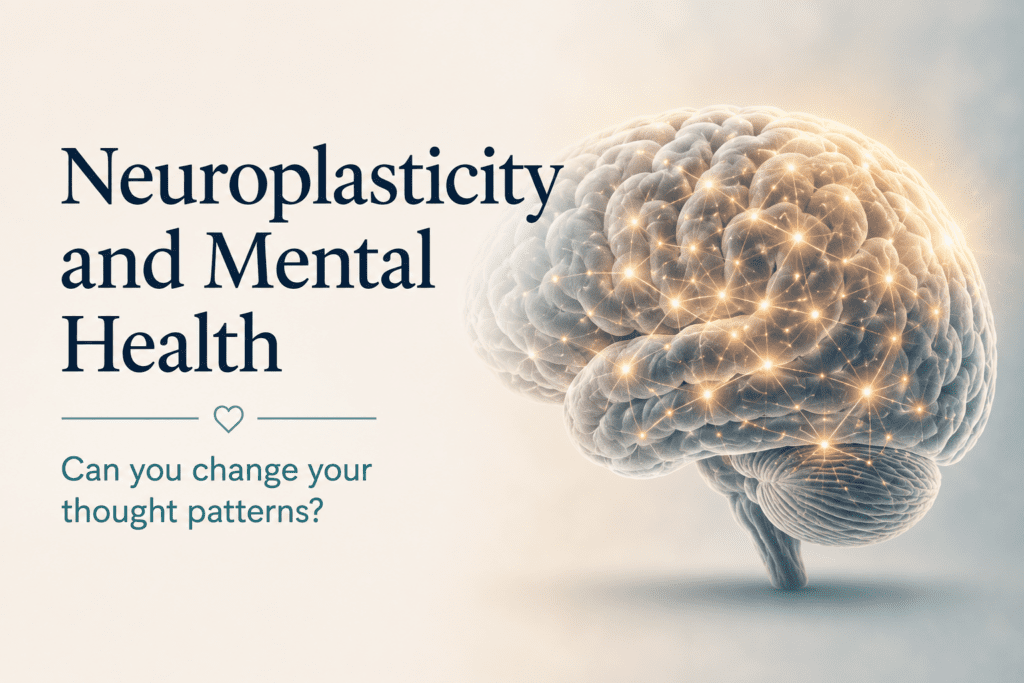
Have you ever noticed how some thoughts seem to appear automatically? Your mind might quickly jump to the worst-case scenario. You might be very self-critical, doubt your abilities, or worry about things that are outside your control.
Many people assume these thought patterns are simply part of who they are. In reality, the brain is shaped by what it does repeatedly.
One of the most important ideas in neuroscience is that the brain becomes more efficient at whatever it practises most. This means repeated patterns of worry, fear or self-criticism can become easier for the brain to return to over time.
The encouraging part is that this process can also work in a helpful direction. When we repeatedly practise self-compassion, emotional regulation, gratitude and healthier ways of thinking, the brain can gradually become more efficient at those responses too.
This ability to change and adapt is known as neuroplasticity.
What is Neuroplasticity
For many years, scientists believed the brain became largely fixed after childhood. We now know this is not the case.
The brain remains capable of adapting throughout life. It does this by creating, strengthening, weakening and reorganising the connections between nerve cells. Every experience, habit, behaviour and repeated thought can help shape these connections.
When certain neural pathways are used again and again, they become stronger and more efficient. In simple terms, the brain gets better at doing whatever it practises most.
A simple way to understand it
Imagine walking across a large field covered in long grass. The first time you cross it, there is no visible path, so you have to push through the grass and the journey takes effort.
If you walk the same route every day, the grass begins to flatten. Over time, a pathway appears. Eventually, that route becomes the easiest one to follow.
Your brain works in a similar way. Each repeated thought, emotion or behaviour strengthens a particular neural pathway. Eventually, those pathways can become the brain’s preferred route. This is why some thoughts begin to feel automatic.
What Happens Inside the Brain?
Several areas of the brain work together to create habits, thought patterns and behaviours. Understanding these systems can help explain why change can feel difficult, and why repeated practice matters when we are trying to build healthier ways of thinking.
The Basal Ganglia – Your Habit Centre
Deep within the brain sits a collection of structures called the basal ganglia. One of its important roles is helping the brain automate behaviours that are repeated frequently.
This is useful in everyday life. Without this system, we would have to consciously think through every step of brushing our teeth, tying our shoes, making tea or driving a familiar route. Instead, the brain stores repeated behaviours so they require less mental effort over time.
The same process can happen with patterns of thinking. If someone repeatedly worries, criticises themselves or expects the worst, those mental habits can gradually become more automatic. The brain is not choosing to make life harder. It is simply becoming more efficient at what it has practised.
The Prefrontal Cortex – The Brain’s Executive Centre
The prefrontal cortex is the area of the brain just behind the forehead. It is often described as the brain’s executive centre because it helps with decision-making, planning, reasoning, problem-solving, emotional regulation, concentration, impulse control and challenging automatic thoughts.
When we are calm and emotionally regulated, the prefrontal cortex helps us pause, reflect and choose how we respond. It gives us the space to question a thought rather than immediately react to it.
However, when we are experiencing prolonged stress, anxiety, depression, poor sleep or emotional overwhelm, this part of the brain can become less effective. Instead of carefully thinking things through, we are more likely to fall back on familiar automatic habits. This is one reason old patterns often return during stressful periods.
Dopamine – More Than the “Feel Good” Chemical
Dopamine is often described as the brain’s “feel-good” chemical, but its role is more complex than that. Dopamine is one of the brain’s important learning signals.
It helps the brain decide:
- What is important.
- What should be remembered.
- Which behaviours are worth repeating.
Each time we repeat a thought pattern or behaviour, dopamine helps reinforce the neural pathways involved. Over time, those pathways become stronger.
This does not only apply to healthy habits. The same learning system can strengthen unhelpful patterns too. Repeated worrying teaches the brain to worry more efficiently. Repeated self-criticism teaches the brain to criticise itself more automatically. Repeated avoidance teaches the brain to avoid challenges more quickly.
The opposite is also true. Repeated self-compassion can strengthen emotional resilience. Repeated gratitude can strengthen positive attention. Repeated problem-solving can build confidence. Repeated healthy coping strategies can support emotional regulation.
The brain is constantly learning from repetition.
The Brain Specialises in What It Practises
If you repeatedly practise:
- Worrying
- Self-criticism
- Catastrophising
- Comparing yourself to others
- Avoiding challenges
your brain gradually becomes more efficient at these responses.
This does not mean you are weak. It does not mean you are “wired that way” forever. It means your brain is doing what it evolved to do: learning through repetition.
Fortunately, the same principle can work in your favour. If you repeatedly practise self-compassion, gratitude, emotional regulation, healthy boundaries, problem-solving, mindfulness and balanced thinking, your brain can begin strengthening these pathways too.
Small actions, repeated consistently, can create meaningful change over time.
Why Change Can Feel So Difficult
Many people become frustrated when they try to think differently but find themselves slipping back into old habits. This is completely normal.
Older neural pathways may have been reinforced thousands of times over many years. New pathways are initially weaker, so they require conscious effort. Just like learning a musical instrument, driving a car or speaking another language, new mental habits take practice.
The fact that something feels difficult does not mean you are failing. It often means your brain is learning something new.
Not Every Thought Is a Fact
One of the most valuable skills developed in therapy is learning that thoughts are not always facts.
Our brains produce thousands of thoughts every day. Some are accurate and helpful. Others are influenced by stress, anxiety, depression, previous experiences, trauma or fear.
A thought such as:
“I’m going to fail.”
or
“Nobody likes me.”
may feel completely true.
But emotions are not evidence. Learning to recognise unhelpful thought patterns is often the first step in changing how we respond to them.
Therapy often helps people pause, notice these thoughts and ask useful questions. Is this thought helpful? Is there another explanation? What evidence supports this? What would I say to someone else if they were having this thought?
Learning to observe thoughts without immediately believing them can reduce their emotional impact.
How Therapy Can Help
Psychotherapy is not about simply “thinking positively”. It is about understanding the patterns your brain has become practised at using, and learning new ways to respond.
Depending on the therapeutic approach, treatment may help individuals:
- Recognise unhelpful thinking patterns
- Develop healthier coping strategies
- Improve emotional regulation
- Increase self-awareness
- Build self-compassion
- Strengthen resilience
- Create healthier behavioural habits
With repeated practice, these healthier responses can become stronger neural pathways. This is one reason therapy can produce lasting change. It gives people the tools and support to practise different responses until those responses become easier to access.
Although lasting change takes time, small actions practised consistently can have a significant impact.
Practical ways to build stronger neural pathways
Lasting change takes time, but small actions practised consistently can have a significant impact.
You might begin by noticing your thoughts without immediately reacting to them. You might practise challenging harsh self-criticism, taking regular movement, prioritising good-quality sleep, building supportive relationships or focusing on what is within your control.
Other helpful practices include gratitude, mindfulness, emotional regulation strategies, celebrating progress rather than perfection, and speaking to yourself with the same kindness you would offer a close friend. Simple self-care practices can also support emotional resilience, stress management and long-term wellbeing.
None of these changes happen overnight. But repeated consistently, they help strengthen healthier pathways within the brain.
A Helpful Visual Explanation
For a visual explanation of neuroplasticity, we recommend this short educational animation by neuroscientist Dr Lila Landowski.
It provides a helpful demonstration of how repeated thoughts and behaviours can strengthen neural pathways, and why practising healthier patterns can support long-term change.
Watch here:
https://www.youtube.com/shorts/Rvmvt7gscIM
Video © Lila Maree Landowski. Shared by linking to the creator’s original YouTube publication. BetterCare™ does not claim ownership of this content.
A Question Worth Asking
The next time you notice a recurring thought, pause and ask yourself:
“If my brain becomes more efficient at what it repeatedly practises, is this something I want to keep practising?”
You do not need to force yourself to “think positively”. Instead, aim to gently practise thoughts and behaviours that support your wellbeing.
Your brain is always learning. The question is what are you teaching it.
A Final Word
Your brain is constantly adapting. Every thought, habit, behaviour and experience leaves a small imprint.
While we cannot always control which thoughts first appear, we can gradually learn which ones we strengthen through repetition.
Meaningful change rarely happens overnight. It happens through many small moments, repeated over time. Each healthier choice helps lay another stone on a new pathway. Over time, that pathway can become easier to follow.
Your brain becomes more efficient at what it repeatedly practises.
What are you practising today?
About BetterCare
BetterCare Mental Health Services supports children, adolescents, adults, families, and workplaces through evidence-based psychology, psychiatry, psychotherapy, occupational therapy, speech and language therapy, and specialist assessments.
Whether you’re looking to better understand yourself, overcome challenges, or build healthier habits, our multidisciplinary team is here to help.
Book a free consultation, call 01 556 3335 or 089 230 0366, or visit www.bettercare.ie to learn more.
References
American Psychological Association. (2023). Neuroplasticity and Behaviour Change.
Doidge, N. (2007). The Brain That Changes Itself. Penguin Books.
Graybiel, A. M. (2008). Habits, Rituals, and the Evaluative Brain. Annual Review of Neuroscience, 31, 359–387.
Hebb, D. O. (1949). The Organization of Behavior: A Neuropsychological Theory. Wiley.
National Institute of Mental Health (NIMH). Brain Basics.
Schultz, W. (2016). Dopamine Reward Prediction Error Coding. Dialogues in Clinical Neuroscience, 18(1), 23–32.
World Health Organisation. Mental Health and Wellbeing.
Landowski, L. M. (2019). Educational animation explaining neuroplasticity and neural pathways. Original publication on YouTube. © Lila Maree Landowski (animation generated in 2010). Linked for educational purposes.
