
Would we accept someone with a mental illness as a neighbour?
Even if someone with a mental illness has recovered, one in ten people said they would be unwilling to live next to them, according to recent research from the UK mental health charity Mind.
When asked more broadly about living with someone who has mental health problems, only 55% of respondents said they would be willing, down from 66% in 2019. For living nearby someone with mental health problems, 75% said they would be willing, down from 81% in 2019.
Attitudes about recovery and support have also shifted. When asked whether people with mental health problems could fully recover, 59% agreed, compared with 67% in 2019. And only 60% said they knew what advice to give a friend to access professional help for a mental health problem, down from 66% in 2019.
The real impact of stigma
The distress caused by mental illness is only partly related to the medical condition itself. Often, the most debilitating aspect is the reaction and attitudes of others—and even of ourselves.
Stigma can take many forms: unkind words, social exclusion, or even financial penalties like higher insurance premiums. As stigma worsens, the day-to-day experiences of people with mental health problems become more difficult, with real-world consequences. Research shows that stigma can make it harder to find or return to employment, secure housing, build friendships, or participate in social activities.
Stigma can also lead to self-stigma—shame and self-blame—and can prevent people from seeking the treatment they need.
Challenging misconceptions
For many, mental illness is wrongly seen as a sign of weakness. There’s a belief that if someone can’t “just snap out of it,” something is inherently wrong with them. This couldn’t be further from the truth.
Mental health conditions such as anxiety and depression are linked to higher risks of chronic physical diseases, including heart disease and diabetes. Seeking treatment improves not only mental health but also physical health.
`
The Myths about Mental Health
Dispelling the myths associated with mental health will reduce the stigma and improve the quality of life for people who experience mental health conditions.
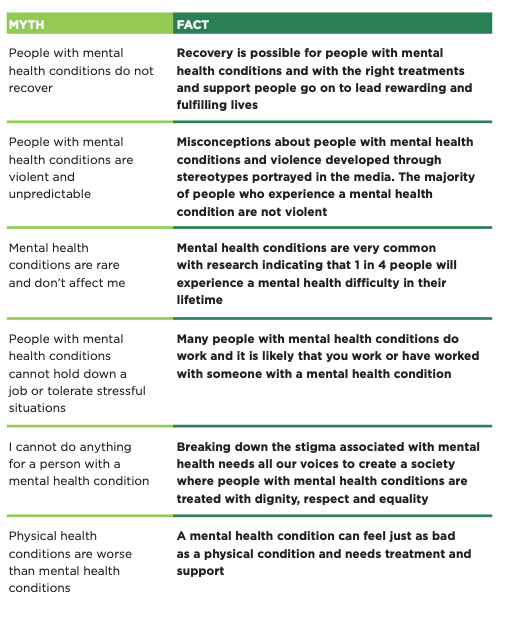
Source: See Change
References
Mind, 2025
The Big Mental Health Report. www.mind.org.uk
See Change, 2020
What is Stigma? Maynooth University. www.maynoothuniversity.ie
